

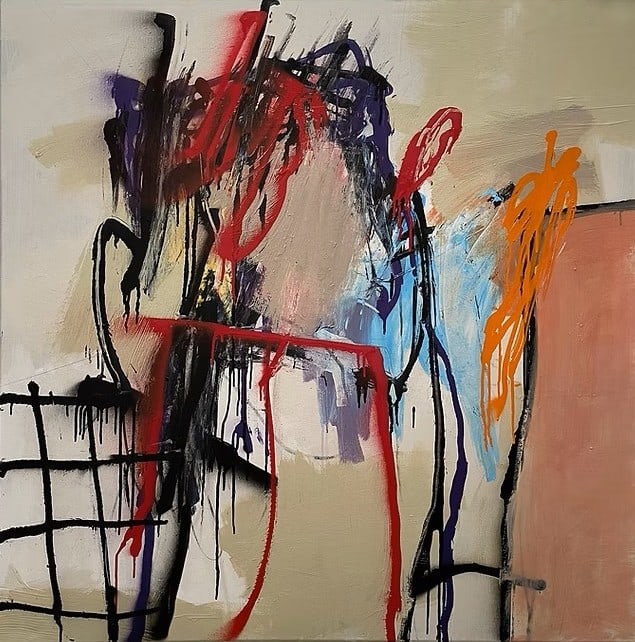
Light Another Candle
$ 99.34
Tim Fawcett studied Fine Art at the University of Sunderland, where he earned a B.A. (Hons). Before that, he completed an Art and Design Foundation Diploma at Anglia Ruskin University in Cambridge. What inspires your work as an artist? I’m inspired by everything I see, hear, and feel in the world around me. My work grows out of a need to make sense of that world — its social and political unrest, its tensions between chaos and order, simplicity and complexity. I’m drawn to creating a visual language that reflects those contradictions. I also look to the spirit of the avant-garde, which I find in music, books, film, art, and everyday life. Those influences fuel the emotional and conceptual undercurrents that shape my practice. Who are your biggest influences? In my early artistic development, I was deeply influenced by the figurative expressionists — artists like Francis Bacon and Edvard Munch, whose emotional intensity still resonates in my work today. In more recent years, I’ve been increasingly drawn to the avant-garde sensibilities of artists such as Cy Twombly, Antoni Tàpies, and De Kooning. Their approaches to gesture, materiality, and poetic abstraction continue to shape the direction of my practice What does your work mean to you? My work is the place where I can express what I can’t elsewhere, how I make sense of things I can’t articulate in words, it’s how I connect with others on an emotional or intuitive level. It means the world to me! What techniques do you use? My techniques centre on exploring what paint itself can do — using paint for paint’s sake. I’m interested in how the material behaves, breaks down, resists, or cooperates, and I let those qualities guide much of the process. Balance and composition on the two-dimensional plane are crucial to me, so I’m constantly adjusting weight, rhythm, and spatial tension. I combine controlled, intentional gestures with moments of spontaneity, allowing concrete structure and chaotic impulse to sit side by side. It’s in that juxtaposition that the work finds its energy.